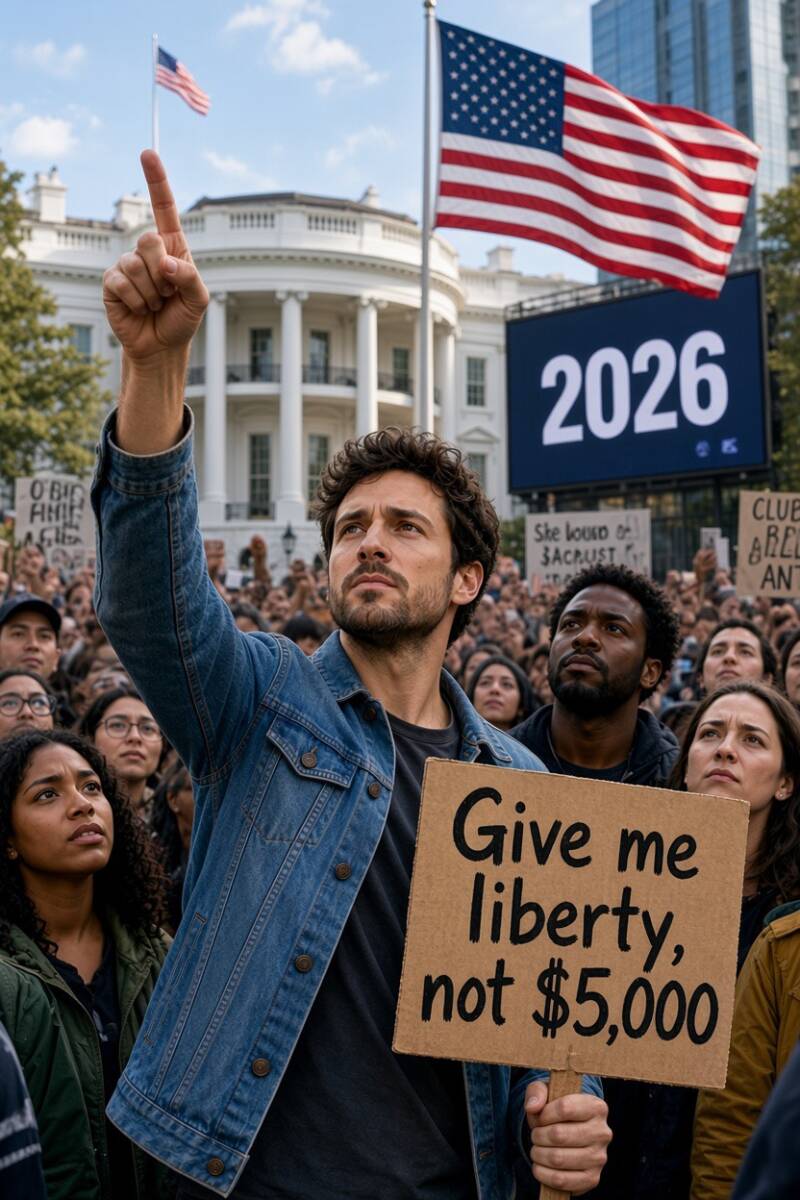
Patrick Henry’s cry was not a request for better terms. It was a rejection of the premise that safety and provision from above could substitute for freedom. “Give me liberty or give me death” drew a hard line: self-rule is not a preference. It is the condition of a free people.
A modern offer of $5,000 tests the same principle in softer language. At the Republican midterm convention in Dallas, Donald Trump promised a $5,000 “dividend” to every adult American if Republicans retain control of both the House and the Senate. He framed it as a successful company distributing cash to its shareholders. With roughly 240 million adult citizens, the headline cost would exceed $1.2 trillion. The numbers, the funding source, and the constitutional path all remain contested. Those are important questions. They are not the deepest one.
What does this tell us about democracy itself?
Representative democracy works through a simple exchange. Citizens give politicians power. Politicians promise to use that power on citizens’ behalf. At election time, citizens decide whom they trust. The system has produced real benefits. It also creates a structural temptation: if winning is the route to power, politicians have a strong incentive to make the most persuasive personal promises possible.
“Vote for us and you will get $5,000” is politically powerful because it changes the psychological question. Instead of asking “What kind of country do I want to live in?”, the voter may begin asking “What am I going to get?” There is nothing irrational about that response. People have bills to pay. But it is worth asking whether this is the best democracy we can create.
Imagine where the logic leads. One party offers $5,000. Another offers $7,000. The first responds with $10,000. Elections risk becoming an auction — not of ideas, but of benefits. The politician asks, “What will persuade you to give me power?” The citizen asks, “What will you give me if I do?” The deeper democratic question can quietly disappear.
Liberty, in modern terms, is not the absence of all constraint, nor is it the freedom to receive whatever is offered. It is the practical capacity of people to shape the rules and conditions under which they live — together, at a scale where their voices can actually matter. It means being able to deliberate about the things that affect daily life and to have those deliberations count. It means power is not permanently outsourced to remote institutions that issue instructions or occasional payments.
A state can distribute money while steadily reducing that agency. The check arrives; the decisions remain elsewhere. Over time, people are trained to evaluate politics by the size of the transfer rather than by whether they remain authors of their common life.
There is another possibility. What if citizens could participate more directly in important public decisions? Not merely “Which politician do you prefer?” but “Here is the proposal. Here is the evidence. Here are the costs and the alternatives. What do you think?” Citizens could learn, discuss, question, propose, deliberate, decide, monitor the outcome, and, if necessary, change course. That is the promise of direct democracy.
Trump’s choice of the word “dividend” is revealing. A dividend is what shareholders receive because they own a company. Citizens are more than shareholders. We live with the consequences of political decisions. We pay taxes, raise families, build businesses, create communities, and generate the wealth and culture of our societies. We are not merely consumers of government. We are the people from whom democratic government derives its legitimacy. That should mean more than the chance to choose who governs us every few years. It should mean a meaningful role in deciding what government actually does.
The most interesting question is therefore not “Would you take the $5,000?” Most people would. The more important question is: would you rather receive $5,000 from a politician, or have a greater say in how your country’s resources are used in the first place?
Those two things are not mutually exclusive. But they represent different visions of citizenship. In one, citizens are largely recipients. In the other, citizens are participants. In one, politicians compete to persuade us to hand them power. In the other, citizens retain meaningful power themselves.
Democracy should not end when we leave the polling station. Voting is essential. Voting once every few years is not the same as governing. A healthier democracy could become something more: learn, discuss, propose, deliberate, decide, implement, monitor, improve. Representatives can still govern. Experts can still advise. Institutions can still administer. But citizens can have a greater voice in the decisions that shape their collective future.
Liberty is not a dividend. It is the prior condition. A free people can choose to provide for one another. A people that has traded self-rule for provision will eventually find that the terms of the provision are no longer theirs to set.
The offer of a check tests what we still remember. The reply should be the older one, updated for the present: liberty first — the power to govern ourselves, not merely the promise of a payment.
Add comment
Comments