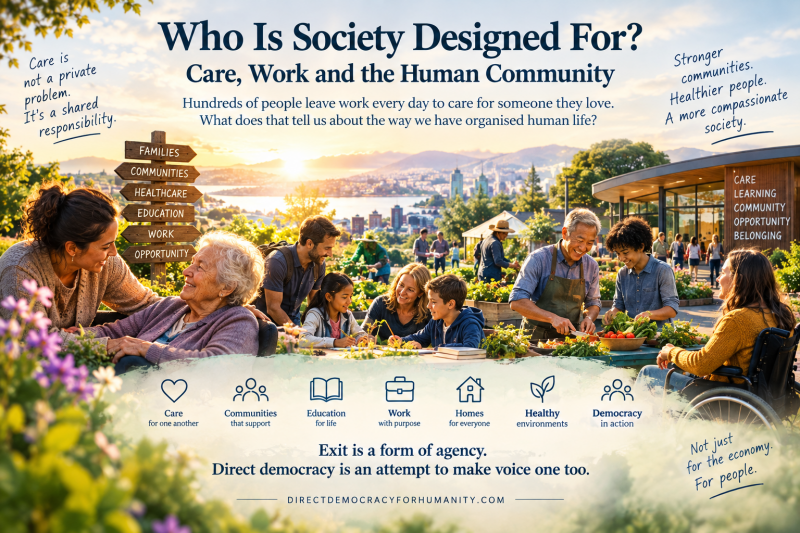
More than 1,500 people a day in the UK are now estimated to leave paid work to care for someone they love. What does that tell us about the way we have organised human life?
We often talk about work, healthcare, social care, families, housing, transport and community as though they are separate parts of society.
But human beings do not experience life that way.
We work. We care for children. We look after ageing parents. We become ill. We support partners, friends and neighbours. We need housing, transport, healthcare, companionship and community.
Life is interconnected.
Our institutions often are not.
And the consequences of that separation are becoming increasingly visible.
Caring is work — even when we don’t call it work
New research for Carers UK estimates that 3.33 million people in the UK have given up paid employment to care for an older, disabled or seriously ill family member or friend.
Around 1.1 million of them are estimated to have done so in the past two years alone.
That is equivalent to more than 1,500 people leaving work every day — compared with around 600 a day in 2019.
At the same time, around 11 million people — one in five UK adults — are estimated to be providing unpaid care.
And one in five workers are now combining paid employment with unpaid caring responsibilities, up from 15% in 2019.
These are not simply statistics about carers.
They are evidence about the way society itself is organised.
Because when more than 1,500 people a day are leaving paid employment in order to provide care, we should ask a bigger question:
Why are work and care organised as though they are competing activities rather than two fundamental parts of human life?
The impossible equation
The modern economy rewards paid employment.
But human life requires much more than paid employment.
People need to raise children.
They need to care for ageing parents.
They need to support relatives living with illness or disability.
They need time to recover when they themselves become unwell.
They need relationships, friendship, community and belonging.
Yet much of our economic and social infrastructure is organised around a remarkably narrow assumption:
The ideal citizen is available for work.
Everything else is expected to fit around it.
When care becomes intensive, the equation can become impossible.
A person may be able to work full-time or provide substantial unpaid care.
But doing both indefinitely may simply not be sustainable.
So eventually, something gives.
For millions of people, it is their paid employment.
We have separated what life keeps together
Healthcare is one system.
Social care is another.
Employment is another.
Housing is another.
Transport is another.
Education is another.
Local government is another.
Community is often treated as something voluntary and informal — almost an optional extra.
But a human being moving through life does not experience these as separate policy categories.
A daughter caring for her mother may need:
-
healthcare
-
social care
-
flexible employment
-
suitable housing
-
transport
-
respite
-
financial security
-
emotional support
-
community
-
friendship
These are not nine separate problems.
They are one human life.
Yet we often ask the individual to navigate nine separate systems.
The family becomes the shock absorber
When institutions do not connect, someone has to absorb the gap.
Very often, that someone is the family.
Families become the shock absorbers between systems.
When formal care is unavailable, families provide it.
When working hours cannot accommodate caring responsibilities, families absorb the lost income.
When transport is inadequate, families drive.
When services are difficult to navigate, families coordinate them.
When someone falls through the gap between health and social care, families step into the gap.
This is not because families are failing.
It is because families are often the last functioning connection between systems that were never designed as one whole.
Care should be community infrastructure
The answer cannot simply be to tell families to cope better.
Nor should the answer be to transfer even more responsibility from the state onto already stretched communities.
We need something different.
Care should be community infrastructure.
Imagine neighbourhoods designed around the reality that people depend on one another.
Shared care networks.
Neighbourhood childcare and respite.
Community kitchens and shared meals.
Intergenerational spaces.
Flexible workspaces.
Shared transport.
Community health and wellbeing facilities.
Gardens, workshops and recreational spaces.
Housing designed for different stages of life.
Places where older people, families, children, disabled people and working adults are not physically or socially separated by default.
The purpose would not be to make neighbours responsible for one another’s care.
It would be to create an environment in which people have more ways to support one another without having to carry everything privately inside individual households.
From isolated households to connected communities
For much of modern life, we have progressively privatised the work of living.
The household is expected to provide care.
The individual is expected to manage work.
Parents are expected to manage childcare.
Families are expected to manage ageing.
Individuals are expected to manage health.
And when something becomes too much, the individual is often told to seek support.
But support is not the same thing as connection.
A person can receive a service and still be profoundly isolated.
A carer can receive a payment and still have no time to meet a friend.
A parent can receive childcare and still live in a neighbourhood where they know nobody.
A disabled person can receive healthcare and still have no meaningful place in community life.
The goal should therefore be more than supporting individuals inside the existing structure.
We need communities designed to share the work of living.
Care should not mean disappearing from society
One of the most damaging consequences of intensive caring is not simply lost income.
It is lost participation.
When people leave work, they can lose colleagues, professional identity, financial independence, opportunities and social contact.
When they become consumed by caring, they can also become disconnected from their wider community.
Their world becomes smaller.
But caring should not mean disappearing from society.
A person should be able to care for someone they love and still have access to meaningful work, relationships, learning, recreation, community and civic life.
These things should not compete unnecessarily.
The challenge is to build communities where they reinforce one another.
The community should help design the care system
This is where the question becomes political in the broadest sense.
Not party politics.
Governance.
Who decides what a community needs?
Who decides where resources go?
Who decides whether a transport service is useful?
Who decides whether a community care facility actually works?
Who decides whether housing meets the needs of different generations?
And who gets to change the system when it doesn’t work?
Too often, decisions are made by institutions and then delivered to communities.
A different model would begin with the people living there.
Residents could identify needs.
Carers could describe the barriers they actually encounter.
Older people could help design services intended for older people.
Parents could help shape childcare provision.
Disabled people could help shape accessibility.
Workers could help design local employment and workspace arrangements.
Professionals could contribute expertise.
Businesses could contribute resources and capacity.
Government could provide funding, standards and accountability.
The community would not replace professional expertise.
It would help shape how expertise and resources are used.
Direct democracy as community infrastructure
One way of organising this relationship is through direct-democratic mechanisms.
The purpose would not be to put every decision to a referendum.
It would be to create structured ways for citizens to participate in decisions that affect their lives.
Communities could deliberate over priorities.
Citizens could propose projects.
Residents could participate in allocating some local resources.
Communities could monitor implementation.
They could evaluate whether something was working.
And they could have mechanisms for changing decisions when circumstances changed.
This creates a different relationship between citizens and the institutions around them.
The point is not that citizens will always make the right decision.
The point is that the people living with the consequences have a meaningful mechanism for shaping the decisions.
That matters particularly for care, because the people who understand the gaps in a care system most intimately are often the people living inside those gaps.
From supporting carers to designing communities around care
We tend to ask:
How can we support carers better?
That is an important question.
But perhaps there is a larger one:
Why have we designed society in a way that makes caring so difficult to combine with the rest of life?
Better employment rights matter.
Better social care matters.
Better financial support matters.
Better healthcare matters.
But these interventions remain fragmented if the underlying architecture remains fragmented.
The deeper opportunity is to connect them.
To create private lives within stronger communities.
To allow people to retain employment without abandoning care.
To allow people to care without becoming socially isolated.
To allow older people to remain connected rather than becoming separated from everyday community life.
To allow children to grow up around multiple generations rather than being segregated into age-based institutions.
To allow professional services and community knowledge to work together.
And to give the people affected by these systems a meaningful role in shaping them.
We should not have to choose between being productive and being human
The language of productivity can make caring appear economically unproductive.
But caring is one of the activities that makes every other form of economic activity possible.
Someone cared for the child who eventually became a doctor.
Someone cared for the worker who eventually built the company.
Someone cared for the parent who spent decades contributing to society.
Someone will eventually care for almost all of us.
Care is not outside the economy because it is unimportant.
It is often outside the formal economy because we have chosen not to organise or measure it in the same way.
And when people leave paid employment to provide that care, society is not suddenly receiving something for free.
The work has simply moved from one part of the system to another.
We should not have to choose between being economically productive and being human.
We need to redesign the way we live
The growing number of people leaving employment to provide unpaid care is not simply a problem for carers.
It is a signal.
It tells us that the way we have organised work, family, housing, healthcare and community is increasingly out of alignment with the realities of human life.
The answer is not to make carers better at coping with an inadequate system.
The answer is to build a society in which people do not have to cope alone.
That means reconnecting the systems we have separated.
It means designing neighbourhoods around human relationships as well as buildings.
It means recognising care as essential social infrastructure.
It means creating ways for professional expertise, public resources, families and communities to work together.
And it means giving citizens meaningful mechanisms to participate in shaping the places where they live.
Not because citizens will always agree.
Not because every community will make perfect decisions.
But because people living together should have a meaningful role in deciding how they live together.
The human community
We often speak about caring as though it is a burden placed upon society.
But perhaps we have the relationship backwards.
Care is not a burden that happens to society.
Care is one of the things society is made of.
Every human being enters life dependent on others.
Most of us will depend on others again at different points in our lives.
And almost all of us will eventually care for someone else.
The question is therefore not whether we can eliminate dependence.
We cannot.
The question is whether we organise human life around that reality — or continue pretending that independence is the norm and care is an exception.
More than 1,500 people leaving work every day to care for someone they love is not simply a statistic about employment.
It is a question about what kind of society we have built.
And perhaps, ultimately, about what kind of society we want to build next.
Because care is not something society needs to fit around human life.
Care is human life.
-
Carers UK — Policy and research library https://www.carersuk.org/policy-and-research/
-
The Independent — 1,500 unpaid carers quitting jobs every day https://www.independent.co.uk/news/uk/home-news/unpaid-carers-quit-jobs-workplace-employment-rights-b3051090.html
-
The Guardian — About 1,500 Britons a day quitting their jobs to become unpaid carers https://www.theguardian.com/society/2026/sep/16/britons-leaving-workplace-unpaid-carers
Add comment
Comments